Plaza Sí Se Puede; or, Connecting the Plaza de César Chávez
Motivation
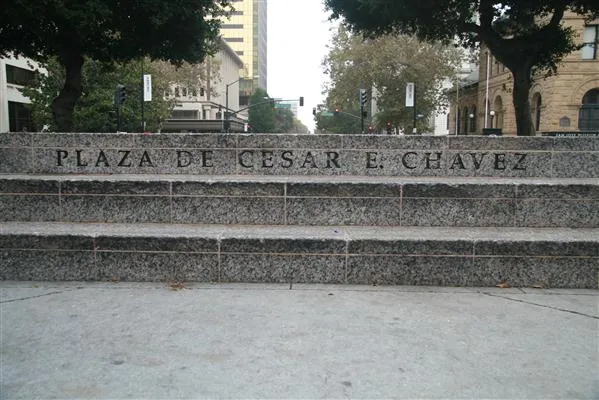
The Plaza de César Chávez sits in a central location in Downtown San Jose. Today, it sees a small number of visitors most days of the year. While special events drive large numbers of visitors, they occur only infrequently, wasting much of its potential when no such event is ongoing. We would see it become a lively place every day, where people go to congregate in downtown, just because they can. We can get there with gentle changes to the Plaza, turning it into what we’re calling Plaza Sí Se Puede.
Plaza Sí Se Puede
Connect the Plaza
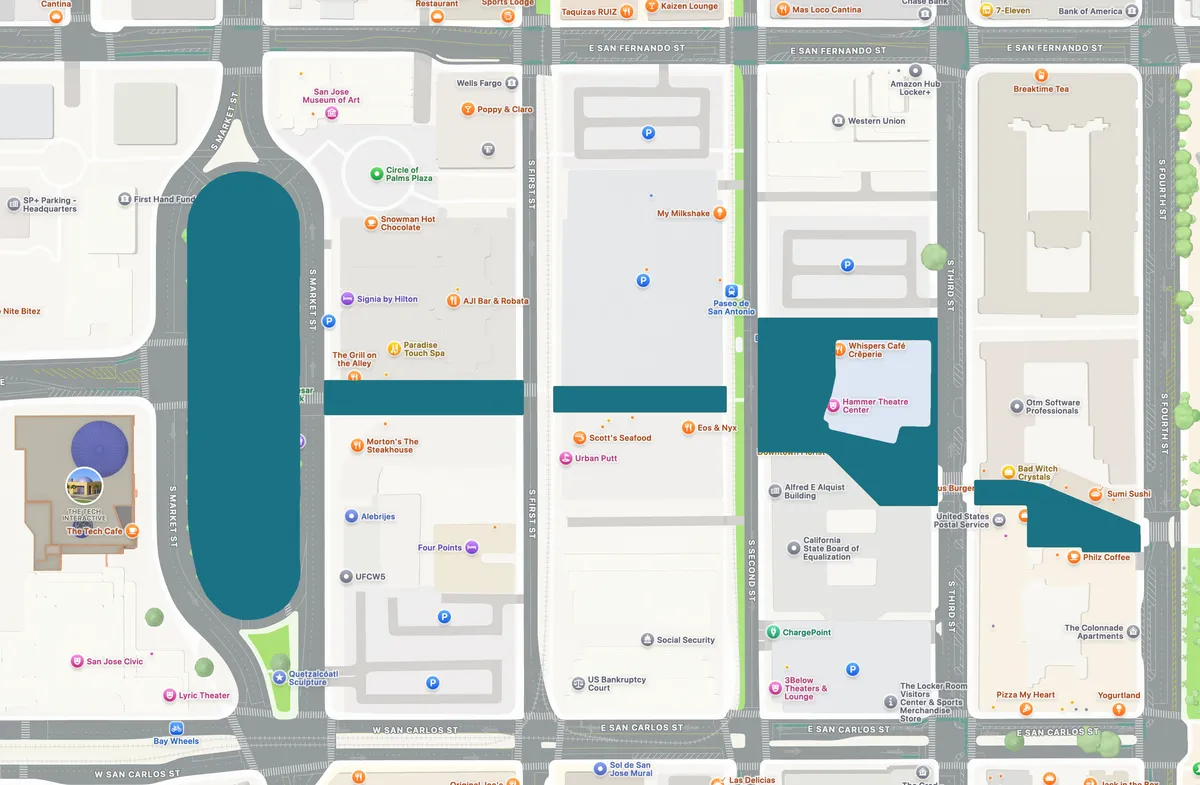
The most important step in making the Plaza a major downtown destination: we must connect the Plaza to its surroundings including San José Civic and Paseo de San Antonio. We require only minor changes to connect it so: limit car and truck traffic on S Market St on either side of the Plaza.
The street around the Plaza need only allow emergency services vehicles as they respond to calls. These vehicles use attention-grabbing emergency lights and sirens, and the drivers among our first responders know how to safely navigate areas with many people. For the businesses adjoining the Plaza, we can allow local delivery traffic with safety measures: they may enter the Plaza mornings from 5am-12 noon, when fewer people will be present. As for the Signia hotel, the segment of Market St between the hotel and San Fernando St becomes a short, two-way road. All vehicles in and around the Plaza must adhere to the common California speed limit for pedestrian conflict-zones, 15 mph.
These tweaks bring immediate benefits. First, the danger of vehicular collisions drops to near zero. While traffic violence impacts us all, children 15 and under in the US especially face danger from vehicles, underscoring the importance of reducing vehicle collisions for child safety. But cutting down on collisions is not the only benefit of limiting vehicle traffic. Cars and trucks produce the majority of the noise and air pollution attributed to cities. The expanded Plaza will provide relief from these hazards.
These connectivity improvements, beyond their health and safety benefits, effectively join the Plaza with its surrounding areas. Allowing people onto Market St here means a no-longer-islanded Plaza, forming a continuous stretch from San Jose Civic all the way to First St via the Paseo de San Antonio. It becomes a single place where one may visit a museum, see a show, and get dinner. A small change transforms the Plaza into a destination in downtown San Jose.
Accessibility
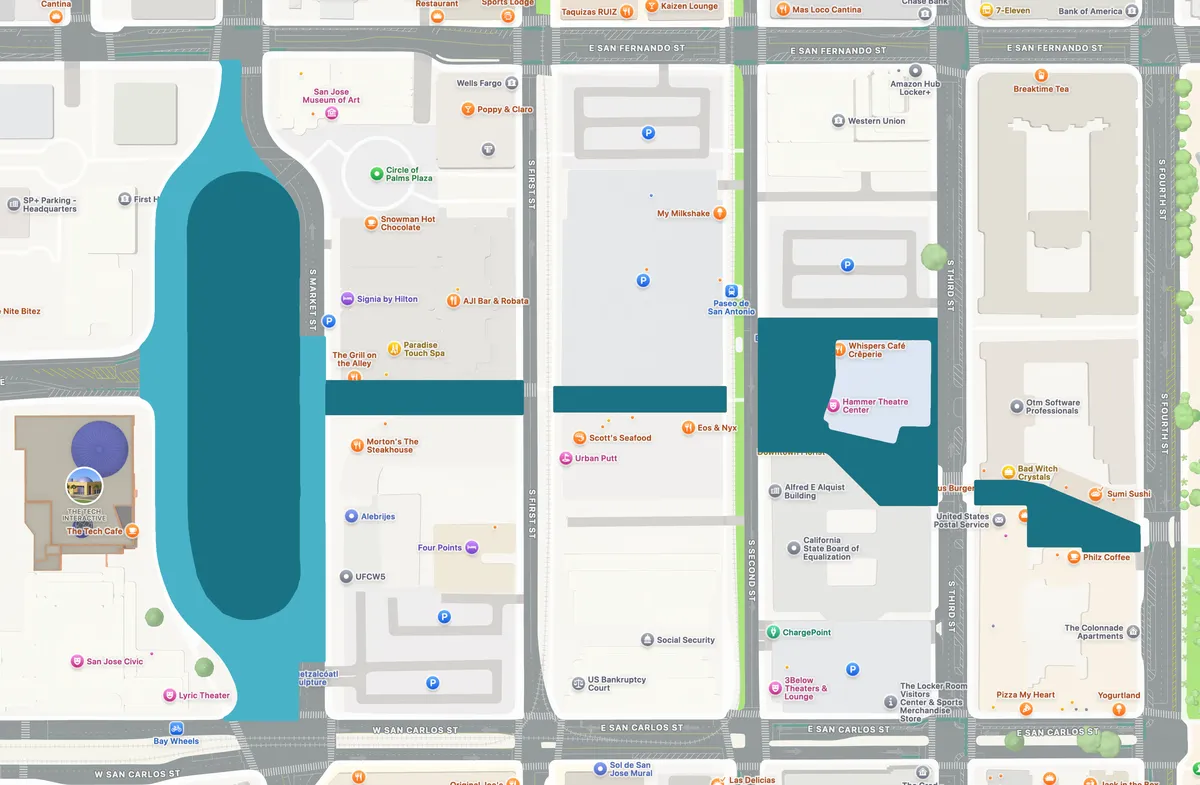
The expanded and improved Plaza would shine for its accessibility. Motor-vehicle-free areas better serve disabled people than their car-involved counterparts, including because disabled people tend to drive less than others in their cohort. Often, they will instead get around by walking, rolling, or taking transit. Coupled with 36% higher rates of vehicle-pedestrian deaths among wheelchair users as compared to the US as a whole, we find that reducing vehicle traffic makes the Plaza more accessible. Connecting the Plaza delivers outsized benefits for disabled people!
Traffic
Almaden Boulevard is the next road to the west, and offers divided north/south travel lanes and a higher 30mph speed limit, compared to the 25mph limit around the Plaza. There is no Plaza to avoid there, no odd mid-block pedestrian crossings. All-in-all, Almaden Boulevard is a nicer road to drive on than S Market St. It is well suited to carrying the traffic formerly passing through the Plaza.
Parking
Fortunately, many prominent locations offer parking nearby to the Plaza. A surface parking lot to the southeast of the plaza, the Fairmont Plaza Garage to the northeast, the Second & San Carlos St garage, the SP+ garage on 2nd St, and more, all accommodate visitors to the area.
Multiple transit stops sit near to the Plaza, for people who wish to visit but can’t or won’t drive. These include the light rail stations, at the San Jose McEnery Convention Center and 1st and Paseo de San Antonio, as well as nearby bus stops along San Carlos and along 1st St.
Why “Plaza Sí Se Puede”?
The name Plaza Sí Se Puede honors the movement creating the National Farm Workers Association (NWFA), the very thing for which Cesar Chavez gained his fame. The NWFA movement remains historically significant to San Jose, and we should continue to recognize that. Yet no movement stands on the shoulders of one person. The New York Times’ reporting on Cesar Chavez’s abuse of girls and women additionally serves as a warning against uncritical praise of Chavez himself. As we consider history in the naming of our places, we must bear this in mind.
By using the NWFA motto “sí, se puede”, we honor the everyday people of the movement in a way that Plaza de Cesar Chavez failed to do. That movement and its motto further continued on into the civil rights and immigration justice movements, both of which we find of continuing relevance to this day. “Sí, se puede” in this way not only reflects the history of San Jose, but the future which we're still working to build.